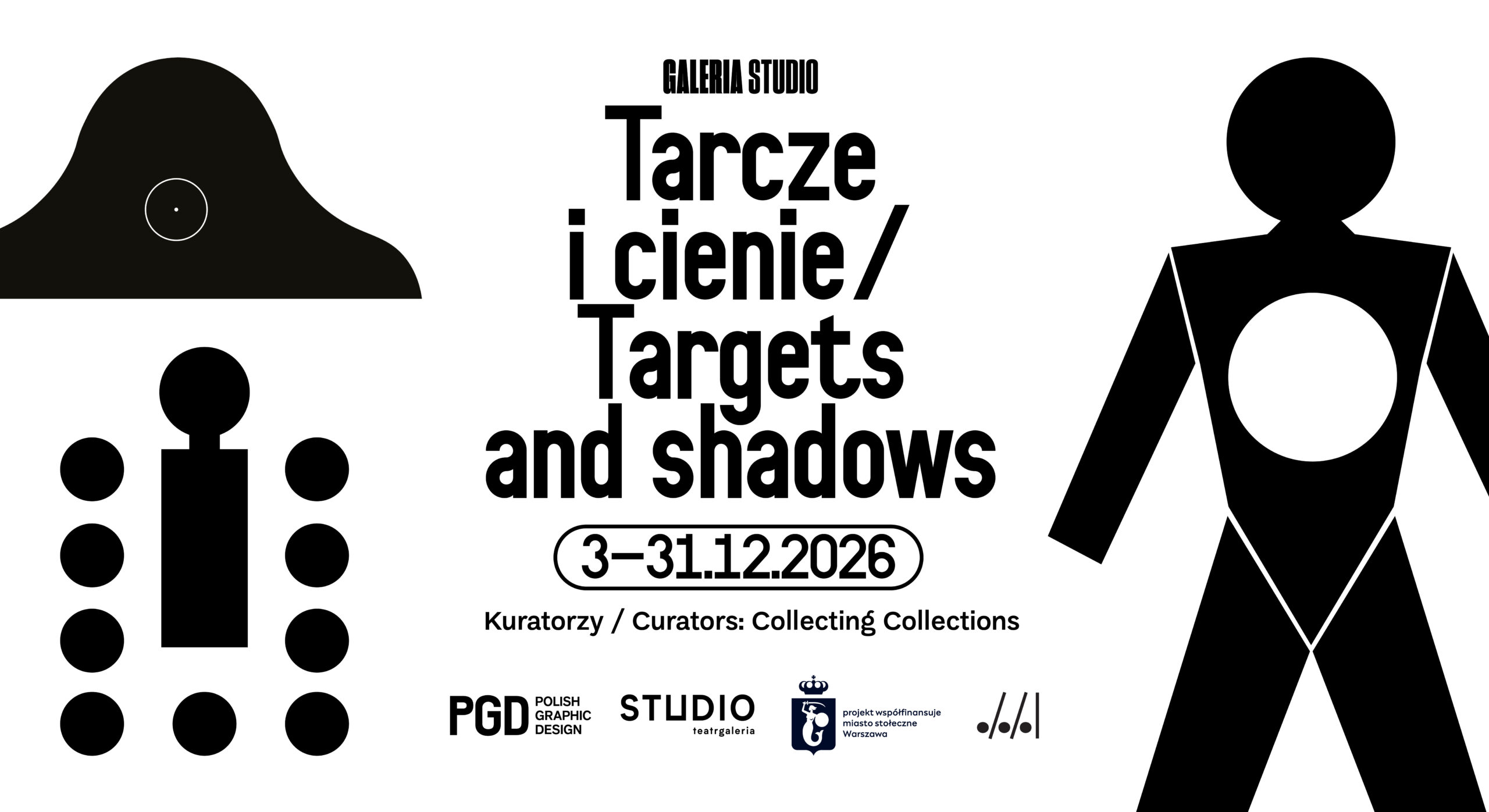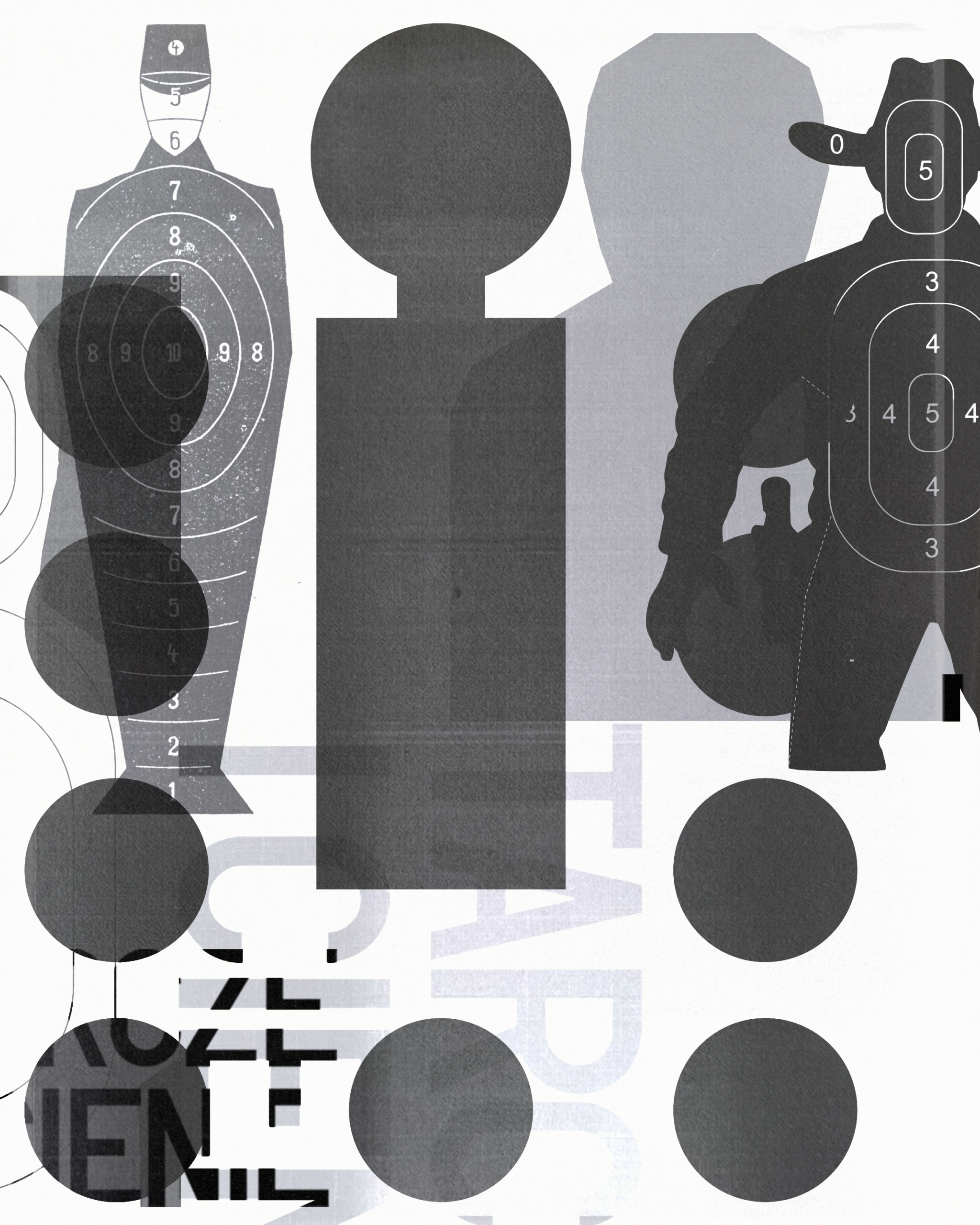
What do we see when we look at a shooting target? What makes us perceive it as a threat? Is it merely a silhouette, an innocent image, or a human being?
The exhibition Targets and Shadows presents a selection of shooting targets from various periods (from the early 20th century to the present day), most of which originate from countries in the Global North. They are arranged on a scale close to a person’s natural height (around 180 cm) and form a group of silhouettes that cannot be viewed merely as a collection of graphic designs. We began working on the exhibition in the spring of 2026. The events of recent months, including the tragic shooting in Kraków, have shattered the fragile sense of security in our society. They have also made the topics of weapons, violence, and defence particularly present in the Polish public debate. We are aware that the images on display may be perceived differently today than they were, when we began working on the project. Although the exhibition does not refer directly to these events, it is impossible to separate it from the reality in which it is being presented.
Our project began as a socio-critical visual analysis of a collection of shooting targets. These are graphic design tools used to train military personnel, police officers, and sports shooters, or which may serve as a form of recreation. The diversity of their forms demonstrates how they are tailored to training objectives such as accuracy, practising reflexes, neutralising, or killing. The development of training techniques, the experience of successive armed conflicts and changing perceptions of the enemy have all influenced the design of these shooting targets. We are interested in the historical and political circumstances surrounding their creation. The creators of most of these designs remain unknown. Their work does not serve purely aesthetic or entertainment purposes. It may also be linked to firearms training which results in violence.
Through their anthropomorphic form, the targets are symptomatic of processes in which reality falls apart. The exhibition title refers to Silhouettes and Shadows (1972–1982), the installation by Józef Szajna, founder of the STUDIO Theatre and Gallery, in which the artist addresses the experience of war and violence. Szajna also employs a simplified human silhouette that bears a striking resemblance to a shooting target, highlighting the ambiguity of this form. The installation comprises a collection of over a dozen human busts. Some of them, covered in grey-brown paint, are anonymous; others bear clear traces of violence; whilst still others present historical photographs of prisoners.
The tension between the physical shape and the mere suggestion of the presence of a human being, reveals the weight of what has been omitted. Here, the shadow becomes not only a trace of the silhouette, but also of that which lies beyond its outline, whilst remaining present within it. We find a similar ambiguity in shooting targets. Their graphic simplification allows us to recognise a human figure, while at the same time reducing it to a mark which can be aimed at. What disappears, and what remains in such a representation? And what, exactly, are we practicing when we learn how to shoot?
Curatorial Team: Collecting Collections (Pola Małaczewska, Marian Misiak)
Collaborators: Michał Grzegorzek, Rene Wawrzkiewicz, Weronika Wojda
Organizers: Galeria Studio, Polish Graphic Design Foundation, Collecting Collections
Texts: Marian Misiak, Pola Małaczewska, Weronika Wojda
Proofreading: Stefa Gosiewsk
Production and layout: Alicja Chełstowska
Visual identity: Marian Misiak, Pola Małaczewska
The Design Fest is co-funded by the City of Warsaw. Financial support: Swiss Embassy in Poland and the Foundation for Polish-German Cooperation. Partners and collaborators: Museum of Modern Art in Warsaw, Museum of Free Belarus, Jerzy Grzegorzewski Studio Gallery, Czech Center Warsaw, Slanted Publishers, and Bar Studio
Collecting Collections
Creativity is about connecting the dots. Collecting Collections will be a recurring publishing project dedicated to interpreting and discovering meanings hidden in seemingly obvious objects. By connecting objects, images, documents, and ideas without the aid of algorithms, it will serve as a space for new perspectives and socially relevant topics. The project’s goal is to use collections to better understand and shape culture.